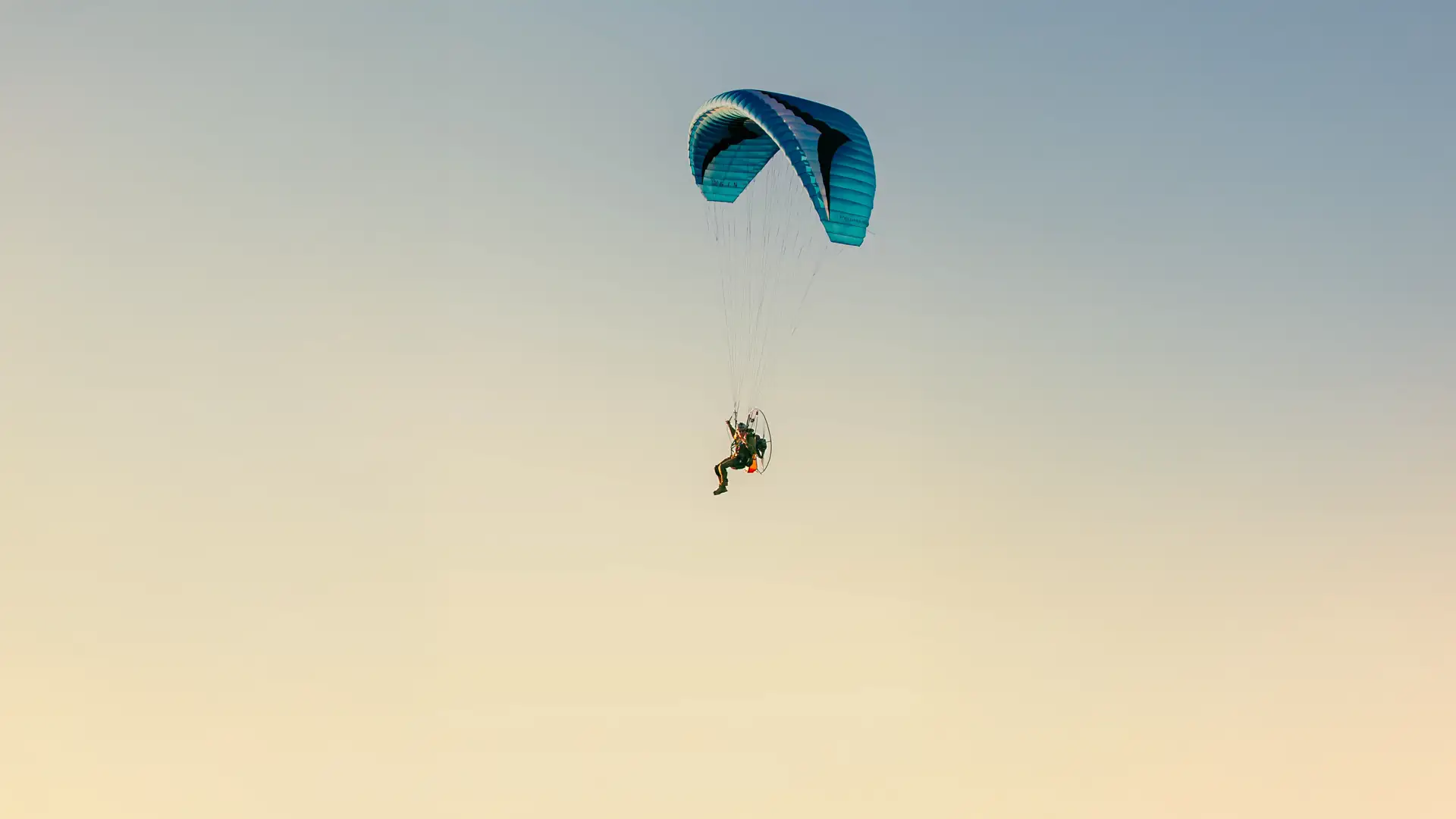
If you've been researching paramotor training in Washington State, you've probably run into a lot of vague information: schools listing "multi-day programs" without explaining what actually happens, or websites full of stock photos that look nothing like the reality of learning to fly a paramotor.
This is a ground-level walkthrough of what our 10-day PPG2 certification course looks like. No marketing language. Just an honest account of what students experience from day one to certification.
Before You Arrive: What to Know
Paramotor training in Washington is weather-dependent. We schedule courses Monday through Friday, and we brief students every morning based on current and forecast conditions before deciding whether we fly, kite, or go to ground school. Every competent paramotor school operates this way.
What you need to bring: athletic clothing you can move freely in, closed-toe shoes with ankle support (trail runners work well), sunscreen, water, and layers. Western Washington weather changes fast. We provide all flight equipment (motor, wing, helmet, and harness).
Our class cap is 4 students. This matters more than most people realize. At larger schools where 8 to 12 students share one instructor, you spend most of your time waiting. With 4 students you are in constant motion: kiting, briefing, watching, debriefing. The learning is continuous.
Day 1: Ground School & First Contact With the Wing
Day one starts in the classroom. We cover:
- How a paramotor works (motor, propeller, harness, wing)
- The physics of how a paraglider generates lift
- FAR Part 103, the FAA regulation covering ultralight vehicles including paramotors
- Washington State airspace basics: how to read sectional charts, use B4UFLY, identify controlled airspace
- Weather reading fundamentals: wind direction, thermals, marine layer behavior in Western Washington
- Pre-flight inspection checklist
After lunch we go to the field. Day one is entirely about the wing, no motor. You will be kiting. Kiting is the process of controlling the paraglider canopy on the ground using the brake toggles, with the wing overhead and the wind keeping it inflated. It sounds simple. It is not.
Most students find kiting humbling on day one. The wing wants to fly, and your job is to keep it exactly overhead, responding to gusts, managing brake pressure, and learning to feel what the wing is telling you. Every competent pilot has spent hundreds of hours kiting. Your ten days of training will begin to build that foundation.
We kite until conditions become unsuitable or until students need a physical break. Kiting is physically demanding. You will be sore.
Day 2: Kiting Refinement & Motor Introduction
Day two begins with more kiting, typically in the early morning when winds are lightest and most consistent. The goal is to get to a point where the wing stays overhead with minimal input. You're building muscle memory that you'll rely on during launches.
Midday we introduce the motor. We start with the paramotor on your back, engine off. You practice the harness fit, the feel of the weight, the way the frame changes your center of gravity. Then we start the engine and you practice throttle control, engine management, and the sound and vibration of a running motor.
You will not fly on day two. Some students are surprised by this. Some are frustrated. We understand. The motor introduction is a safety step. We want your body to be completely comfortable with the weight and sound before we add motion.
Day 3: First Flights
Day three is typically when first flights happen, but only if kiting is solid. If your ground handling isn't where it needs to be, we kite more and fly later. There are no shortcuts here. Students who launch before their kiting is dialed in have avoidable accidents.
First flights are brief: launch, climb to 50 to 100 feet, a gentle turn, and land. The instructor is on the ground with a radio. We debrief every flight immediately: what you did well, what needs work, what to do differently on the next pass.
Most students fly 3–6 times on day three. Each flight gets a little longer as comfort and control improve. By the end of day three, most students are flying circuits at 200–400 feet and beginning to work on landing consistency.
Day 4: Building Confidence
Day four is where things start to feel more like flying and less like surviving a flight. You'll work on:
- Precision landings: consistently touching down in a target zone
- Flight planning: reading the wind, choosing a traffic pattern, anticipating drift
- Altitude management: knowing when to climb, when to descend, how to manage fuel burn
- Emergency procedures: what to do if the engine quits, how to manage a collapse
- Cross-wind launches and landings if conditions allow
Most students have their best flights on day four. The initial anxiety is gone, the mechanics are becoming automatic, and there's headspace to actually enjoy what it feels like to fly.
Some students complete their PPG2 certification test on day four if proficiency is there. Others complete it on day five.
Day 5: Certification & Next Steps
Day five wraps up any remaining flight requirements, completes the PPG2 certification evaluation, and covers post-course planning: gear selection, airspace resources, finding flying sites, weather tools, and how to keep building hours safely.
PPG2 certification means you have demonstrated the ability to operate a paramotor solo, safely, in suitable conditions. It is not a guarantee that you're an experienced pilot; that comes with time and hours. But it is the recognized industry standard, and it opens doors: flying sites, events, landowner access, and the respect of other pilots.
What Washington State Is Like for Paramotor Training
Western Washington has a marine climate, which means mornings are often the best flying window. The marine layer burns off by mid-morning most days in summer, leaving calm, smooth air that's ideal for students. By afternoon, surface heating creates thermals and convective activity that makes conditions more demanding. We time training around this.
The terrain variety in Washington is exceptional. Within an hour of Seattle you have flat river valleys for early training, coastal terrain for beach flying, and the Cascade foothills for more advanced sessions. As a certified pilot, you'll have access to some of the most scenic flying in the country.
Is 10 Days Enough?
For most students: yes, to reach PPG2 certification. To become a proficient, confident pilot: no. That takes months of post-certification flying. Ten days is the foundation. What you do with it after is up to you.
Some students need a follow-up session to complete certification if weather cuts into flying time during the week. We track student progression and work with you on this if needed.
Ready to Start?
If you're in Washington State (Seattle, Tacoma, Bellingham, Everett, Olympia, or anywhere in between), Seattle Paramotor runs certification courses year-round with seasonal scheduling based on weather windows.
If you want to experience the sport before committing to a full course, our Intro Flight program puts you in the air with an instructor before you spend a dollar on training.
Questions? Contact us directly. We respond to every inquiry personally.
Seattle Paramotor Instructors
Expert paramotor instructors operating across Washington State.
Keep Reading
Ready to Get Started?
Check open class dates or book an intro flight. It's the best way to know if paramotoring is right for you.